
The first verse of “Shwaas” has Shreyas Sagvekar writing from the 20th floor, looking out at a city that looks good from up there. That's literal. The song came to him at a studio, twenty floors above Mumbai, with slums crawling nearby, while producer Kimeraa played him beats to jam on.
It was the first time the two had met. Sagvekar, the voice behind the global hit “Taambdi Chaamdi,” walked in to find that Kimeraa already had a beat; “Shwaas” was the second one he played. Sagvekar started spitting bars almost immediately and what came out of that room was a bass-heavy Marathi grime record built around one refrain, “Tu gheun dakhav mokla shwaas,” a dare to take a free, open breath.
The second verse is where the writing earns its anger. Sagvekar puts himself in a car with the AC running and traffic as the only complaint, then cuts a tin-sheet house against a wall: one 80-watt bulb, a stove burning, a child asleep beside it, and the verse’s last line, “Aani kachryacha vaas!” (and the smell of garbage!). It’s the verse where he doesn’t stand outside the problem, and he says so when asked whether writing himself into it was uncomfortable. “Accepting that I am also a part of the problem only helped us manage the problem better,” he said, adding that what he feels is sadness that everyone has contributed to this.
The first and third verses are less sure-footed. The city of gold, the darkness lying over the lights, “Ekikade kinarpatti, ekikade zopadpatti” (a coastline on one side, a slum on the other): the paired contrasts are the familiar grammar of the two-Mumbai song, and the third verse repeats its opening four lines, which keeps it on the setup longer than needed. The sharper observations come when he gets specific, like “Tya dhakkyane halatat bhinti" (the walls shake from that jolt, the local train passing), or "Paavsaatun gataar vaahta, naay maticha vaas" (the gutters run with the rain, and there's no smell of earth).

Photo: YouTube/Shreyas Sagvekar
The hook comes back every verse, chanted four times in a row. Asked who he’s daring, Sagvekar said, “You, myself, every listener, and also everybody who is ignoring the current state of Mumbai. Are you really unaware?” Kimeraa’s treatment of it is the one detail in the song that isn’t a lyric. Every time the word “shwaas” lands, there’s a low panting in the back of the mix, put deliberately to carry the claustrophobia.
Kimeraa describes the beat as grungy and angry, and says Sagvekar’s delivery brought out the pent-up angst already in it. He also left things out. None of the obvious texture a song about Mumbai could have, is in the track. “We wanted the message to be out and loud without anything that could take away from it,” he said. He built the record around the message, which suits a song with no interest in decorating its subject, and leaves the track resting almost entirely on Sagvekar’s writing.
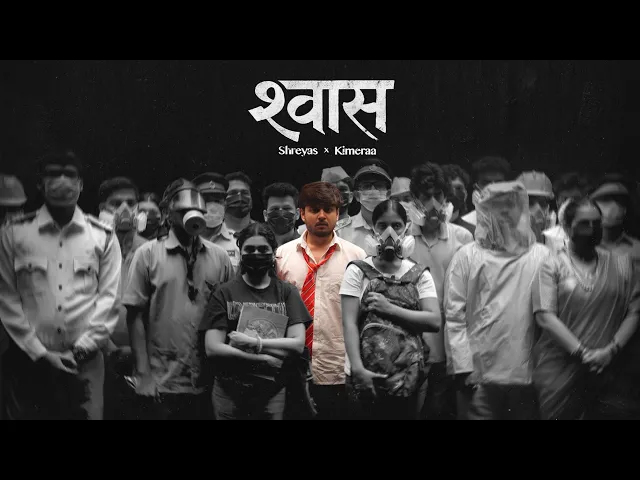
The music video keeps everything in black and white, except red, which does something specific. It picks out the lead’s tie, a Zomato delivery partner and a shop that sells air, which turns the song’s title into a storefront, a breath with a price on it. Colour in the video is conditional, with the mud being the condition. The main character leaves his house for the office in full colour; one step in the mud and the frame moves into black and white. Near the end he wakes up in what looks like a bad dream and the colour returns, for exactly as long as it takes him to step in mud again. The loop is the video’s sharpest move. Waking up doesn’t get him out of it, and neither does the colour returning. All it gives him is awareness of the situation.
Asked to finish the sentence “The day I can breathe easy in this city, it will mean…,” he said, “That there’s a little hope for us left.” A bleak answer for a song framed as a dare.
Tags:
Shreyas Sagvekar


